
Question

Ai4Process
Ai4Process
PL
Ai4Process
Posted: May 17, 2024
Last activity: Jun 20, 2024
Last activity: 20 Jun 2024 7:51 EDT
Closed
App Studio - Creating configurations results in lower compliance score
Hello Community!
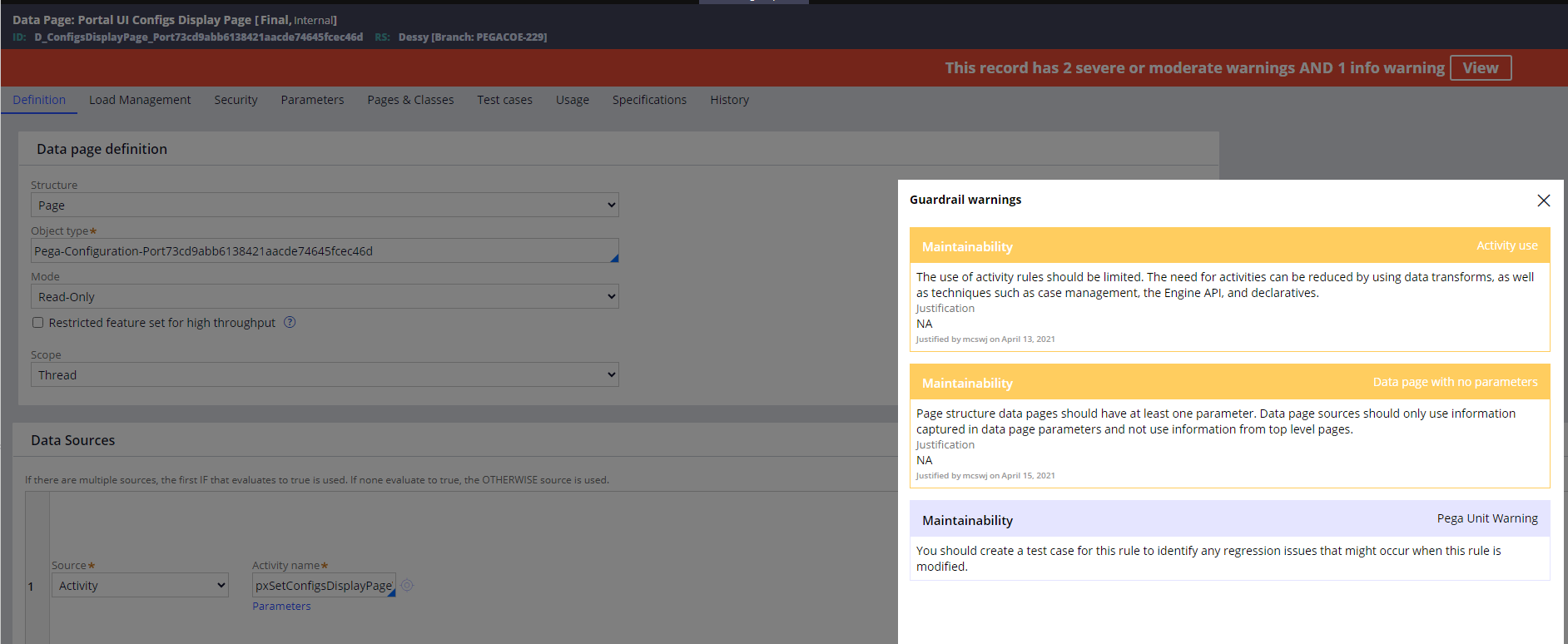
Do you have any idea how to safely get rid of a warning in Data Page during creating Configuration/Configuration set?
What is the point of the warnings in the rules auto-generated by Pega itself? Shouldn't compliance score be not affected by those?
I would justify them, but it still impacts compliance score and we are obligated to keep compliance score at certain level (even towards Pega).
Posted: 1 year ago
Updated: 1 year ago
Updated: 20 Jun 2024 7:47 EDT

MOD
Pegasystems Inc.
GB
Posted: 1 year ago
Updated: 1 year ago
Updated: 14 Jun 2024 10:52 EDT
Ai4Process
Ai4Process
PL
@MarijeSchillern This is not a solution. As mentioned even justified warning impact compliance score. Configurations are recommended right now over old pattern DCR. They should not lead to warnings in the application.
@Pawel Sobolewski Warnings in Pega are designed to draw your attention to configurations that may introduce potential risks to your application, including performance, data integrity, and maintainability. Even if these warnings are in auto-generated rules, they serve as checkpoints for you to review the configuration.
If you believe the warning is justified due to your application's specific requirements, you can justify the warning. Justifying a warning explains why your application is exempt from a best practice, or guardrail. By documenting which warnings are intentionally unresolved, you can improve your compliance score. However, it's important to note that a justified warning still has an impact on the compliance score, but it's 5 times less than an unjustified warning.
If you're required to maintain a certain compliance score, you should aim to resolve as many warnings as possible and justify those that are necessary for your application's functionality.
⚠ This is a GenAI-powered tool. All generated answers require validation against the provided references
Resolving an application warning
Compliance score logic
@Pawel Sobolewski Warnings in Pega are designed to draw your attention to configurations that may introduce potential risks to your application, including performance, data integrity, and maintainability. Even if these warnings are in auto-generated rules, they serve as checkpoints for you to review the configuration.
If you believe the warning is justified due to your application's specific requirements, you can justify the warning. Justifying a warning explains why your application is exempt from a best practice, or guardrail. By documenting which warnings are intentionally unresolved, you can improve your compliance score. However, it's important to note that a justified warning still has an impact on the compliance score, but it's 5 times less than an unjustified warning.
If you're required to maintain a certain compliance score, you should aim to resolve as many warnings as possible and justify those that are necessary for your application's functionality.
⚠ This is a GenAI-powered tool. All generated answers require validation against the provided references
Resolving an application warning
Compliance score logic
LSA Data Excellence: Eradicate or Justify Guardrail Warnings raised when using
Justifying an application warning
Improving your compliance score